Writing
Designing a Hotel Booking Service Like Expedia
Designing a hotel search and booking aggregator that connects travelers to prices and inventory from thousands of hotel suppliers.
Understanding the Problem
Expedia is an online travel platform where travelers compare booking options from different providers and book travel in one place. We’ll design its hotel search and booking experience: aggregate hotel information, prices, and availability from thousands of hotel brands and third-party suppliers, then let travelers compare options and make a reservation.
Our service does not operate hotels or create room inventory. Each supplier controls its inventory and may sell the same rooms through other websites. We own the customer’s booking workflow, while the supplier makes the final inventory reservation decision.
Functional Requirements
Core requirements
- Users should be able to search for hotels by check-in/check-out dates, guest count, room count and location. Users can optionally filter results by price, amenities, and star rating. Location is represented by latitude/longitude and a search radius.
- Users should be able to view hotel listings and compare booking options. A booking option combines a room type from a particular supplier, the selected dates and room count, a total price, and booking terms such as cancellation rules and included meals.
- Users should be able to select a booking option and book it, complete payment, and retrieve a confirmed, pending, or failed status. A booking is the reservation record created when the traveler proceeds with a selected option. Our service places an internal hold on the requested room quantity for every night of the stay for up to ten minutes during checkout. This coordinates competing customers within our service; final availability and reservation confirmation still come from the supplier. Abandoned holds expire automatically.
To support these features, the system must ingest hotel information, prices, and availability from hotel brands, independent hotels, and third-party APIs. At booking time, it must revalidate the selected booking option, including its room type, dates, quantity, and price, and request an actual reservation from the supplier; an availability check alone does not reserve inventory.
Below the line (out of scope for the initial design)
- Hotel administration, physical room assignment, and property operations.
- Flights, rental cars, packages, loyalty programs, and reviews.
- Booking modifications and customer-initiated cancellations. Cancellation terms still appear in the contract; cleanup of failed bookings and payment refunds remain part of booking correctness.
Non-Functional Requirements
Core requirements
- Availability and latency: Prioritize availability for browsing, with search responses under 500 ms at p95. Search may show a recent snapshot; it must not imply that displayed inventory is already reserved.
- Booking consistency: Acquire internal holds atomically across every night of the stay, so competing customers cannot claim the same locally available capacity. Confirm a booking only after the supplier has reserved the requested room quantity for every night and the required payment outcome is verified. Internal holds coordinate our customers; the supplier resolves competition from other booking sites.
- Scalability: Support thousands of supplier integrations and a read-heavy workload. For this exercise, assume 100,000 properties, 10,000 peak searches/second, and 100 peak booking attempts/second; these are sizing assumptions, not Expedia’s actual traffic.
- Durability and recovery: Preserve accepted booking requests and verified supplier/payment outcomes across failures. Retries must not create duplicate reservations or charges. An ambiguous external timeout remains pending until resolved or a recovery deadline starts compensation; a slow supplier must not block unrelated suppliers.
- Security: Authenticate booking actions, authorize access to each user’s bookings, protect traveler information, and verify supplier/payment messages. Collect card details through provider-hosted payment fields or checkout; our application receives payment references and must not receive, store, or log raw card details. Clients cannot set the final payable amount or declare a booking paid.
Core Entities
We’ll start with the entities needed for search and booking, then define their database schema later.
| Entity | Description |
|---|---|
| Customer | The user making a booking. |
| Hotel | A property, including its location and amenities. |
| RoomType | A category such as Standard Queen, with its capacity and features. The hotel handles physical room assignment. |
| Supplier | A hotel chain or third-party provider supplying availability, prices, and reservations. |
| RoomNightAvailability | Our latest snapshot of availability for a supplier’s room type on a particular night. |
| Booking | A customer’s reservation attempt, including dates, room quantity, agreed price, supplier, internal hold expiry, and current status. |
| Payment | A payment attempt associated with a booking. |
A booking option is assembled from our catalog, supplier prices, and availability for the customer’s search. It does not require a separate database table. When the customer proceeds with an option, we create a durable Booking record.
We retain each supplier’s hotel and room-type IDs alongside mappings to our internal IDs. This lets us show one hotel across multiple suppliers and request the correct supplier product at checkout.
RoomNightAvailability stores supplier-reported availability. We track internal holds separately and account for them when admitting competing booking attempts. Supplier refreshes must preserve those active holds. An internal hold cannot reserve a room against customers using other websites; the supplier must accept the reservation.
API Design
Search for hotels
Endpoint: GET /v1/hotels/search
The customer provides a location, dates, guest count, room count, and optional filters. We’ll start with page-based pagination and discuss cursor-based pagination as a follow-up.
GET /v1/hotels/search?lat=37.7749&lon=-122.4194&radius_km=10&check_in=2026-11-10&check_out=2026-11-13&guests=2&room_count=1&min_stars=3&page=1&page_size=20Dates use the hotel’s local calendar, with check-out excluded from the stay. Other optional filters include price and amenities.
Response: 200 OK
{
  "hotels": [
    {
      "hotel_id": "hotel_123",
      "name": "Harbor Hotel",
      "location": { "lat": 37.78, "lon": -122.41 },
      "star_rating": 4,
      "amenities": ["wifi", "parking"],
      "booking_options": [
        {
          "booking_option_id": "option_abc",
          "room_type_id": "room_type_456",
          "room_type_name": "Standard Queen",
          "supplier_id": "supplier_789",
          "check_in": "2026-11-10",
          "check_out": "2026-11-13",
          "guests": 2,
          "room_count": 1,
          "total_price": { "amount_minor": 54000, "currency": "USD" },
          "terms": { "cancellation": "non_refundable", "meals": "none" },
          "availability": "available",
          "expires_at": "2026-10-04T22:10:00Z"
        },
        {
          "booking_option_id": "option_def",
          "room_type_id": "room_type_457",
          "room_type_name": "Deluxe King",
          "supplier_id": "supplier_789",
          "check_in": "2026-11-10",
          "check_out": "2026-11-13",
          "guests": 2,
          "room_count": 1,
          "total_price": { "amount_minor": 72000, "currency": "USD" },
          "terms": {
            "cancellation": "free_until_deadline_then_non_refundable",
            "free_cancellation_until": "2026-11-08T18:00:00-08:00",
            "meals": "breakfast_included"
          },
          "availability": "available",
          "expires_at": "2026-10-04T22:10:00Z"
        }
      ]
    }
  ],
  "page": 1,
  "page_size": 20,
  "has_more": false
}
We return hotels with nested booking options, so customers can compare properties and then choose a room and price. Pagination counts hotels. The total price covers the requested stay and room quantity, including applicable taxes and fees.
The service queries our locally stored hotel information, supplier prices, and availability to find room types available across the entire stay. Availability is best-effort: an internal hold can reject a stale result, and the supplier can still reject the reservation if inventory was sold elsewhere.
booking_option_id is an opaque reference to a short-lived, server-side cached option containing the supplier product, search parameters, price, and terms. It does not require a permanent booking-options table. Its expiry limits how long the customer can select it; it does not guarantee the price or reserve inventory.
Hold a booking option
Endpoint: POST /v1/booking-options/{booking_option_id}/hold
The customer identifies the selected option in the path. No request body is needed. The backend derives the customer ID from the verified authentication token.
POST /v1/booking-options/option_abc/hold
Authorization: Bearer <access_token>
Idempotency-Key: <unique_key_for_this_hold_attempt>
The service resolves the option and atomically checks and claims the requested quantity across every room-night in its local booking database, accounting for existing internal holds and booking allocations. If any night is missing or has insufficient local capacity, the entire operation fails. On success, it creates the booking and records the internal hold in the same transaction.
Response: 201 Created
{
  "booking_id": "booking_xyz",
  "status": "held",
  "hold_expires_at": "2026-10-04T22:15:00Z",
  "quoted_total": { "amount_minor": 54000, "currency": "USD" }
}
The internal hold lasts up to ten minutes. The booking ID identifies it for subsequent checkout steps; access still requires authentication and ownership checks, so a separate hold token is unnecessary here. Repeating the same request with the same customer-scoped idempotency key returns the original result without creating another hold. Reusing that key with different input is rejected.
Return 409 Conflict with a reason such as OPTION_EXPIRED or UNAVAILABLE when the customer needs to refresh their selection. Prices and terms come from server-side data, not client-supplied amounts.
We target 200 ms at p95 for this internal hold operation. It coordinates customers within our service using strongly consistent local state. Supplier revalidation and reservation happen during the subsequent booking flow; this response does not guarantee external inventory or final pricing, and any price change requires customer acceptance before payment.
Confirm booking with payment
Endpoint: POST /v1/bookings/{booking_id}/confirm
The customer submits a tokenized payment method obtained through the payment provider’s hosted fields or checkout. The booking ID is in the path; the backend obtains the customer identity from authentication and the payable amount from the booking record.
POST /v1/bookings/booking_xyz/confirm
Authorization: Bearer <access_token>
Idempotency-Key: <unique_key_for_this_confirmation_attempt>
Content-Type: application/json

{
  "payment_method_token": "pm_example"
}
The service checks that the customer owns the booking and that its internal hold has not expired. It atomically moves the booking from held to pending so only one confirmation attempt can proceed at a time. It then revalidates availability, price, and terms with the supplier and requests a supplier hold where supported. A price or terms change requires customer acceptance before charging.
With the supplier hold secured, the service charges through the payment gateway and finalizes the supplier reservation before marking the booking confirmed. A supplier availability check alone is insufficient. For suppliers without holds, the reservation and payment ordering depends on their API; failed partial completion requires cancellation or refund, and uncertain outcomes require reconciliation.
Response: 200 OK
{
  "booking_id": "booking_xyz",
  "status": "confirmed",
  "supplier_confirmation_id": "reservation_987",
  "payment_status": "succeeded",
  "total_paid": { "amount_minor": 54000, "currency": "USD" }
}
If payment is definitively declined, the booking can return to held while its original internal hold remains valid, allowing the customer to retry. Any supplier hold must be released or tracked through its expiry, and a retry rechecks supplier availability. The retry does not restart the ten-minute internal hold.
The booking ID prevents a second successful confirmation: confirming an already-confirmed booking returns its existing result. The idempotency key identifies an individual confirmation attempt. Network retries reuse the same key; a new payment attempt after a definitive decline uses a new key. Supplier and payment operations also use stable keys for their respective attempts, so retries cannot create duplicate reservations or charges.
If a supplier or payment response is uncertain, return 202 Accepted with status: "pending" while the service reconciles the outcome. Do not start another charge or release the booking’s allocation merely because the original hold deadline passes during an unresolved confirmation. If payment succeeds but the supplier definitively rejects the reservation, refund the payment and record the failed booking and refund progress.
After confirmation, the service durably records an event for asynchronous confirmation email delivery and, once introduced, availability cache invalidation and search index updates. These background tasks do not delay the successful response. Payment, supplier reservation, and our database update are separate operations; recovery handles failures between them.
Get booking status
Endpoint: GET /v1/bookings/{booking_id}
The customer can check the booking at any time, including after a timeout or while confirmation is pending. The service reads the current booking and payment state from our database and verifies that the authenticated customer owns the booking. This request does not extend the hold or initiate another payment.
GET /v1/bookings/booking_xyz
Authorization: Bearer <access_token>
Response: 200 OK
{
  "booking_id": "booking_xyz",
  "status": "held",
  "hold_expires_at": "2026-10-04T22:15:00Z",
  "payment_status": "failed",
  "can_retry_payment": true,
  "quoted_total": { "amount_minor": 54000, "currency": "USD" },
  "supplier_confirmation_id": null
}
This example represents a failed payment attempt while the internal hold is still valid. The customer can retry within the remaining checkout window.
| Booking status | Meaning |
|---|---|
held |
The internal hold is active and checkout can continue. |
pending |
Confirmation is in progress or an external outcome is being reconciled. |
expired |
The checkout window ended without an active confirmation attempt; the internal allocation is released automatically. |
failed |
Fulfillment failed because the supplier rejected it or its resolution deadline passed; refund/cancellation recovery may still be in progress. |
confirmed |
The supplier reservation and required payment outcome are verified. |
Payment state is returned separately as not_started, pending, succeeded, failed, refund_pending, or refunded. This lets the UI show Payment failed while the booking remains held, or show refund progress for a failed booking. can_retry_payment is computed by the server from the current state and hold deadline; the confirm endpoint checks both again before accepting a retry.
The hold endpoint stays fast by coordinating local capacity, while confirmation handles the slower supplier and payment calls. The hold deadline gives customers a bounded checkout window. We’ll cover hold expiry races and late payment arrivals in the deep dive.
High-Level Design
1. Users should be able to search for hotels
Let’s start with an API Gateway, a Search Service, and a database.
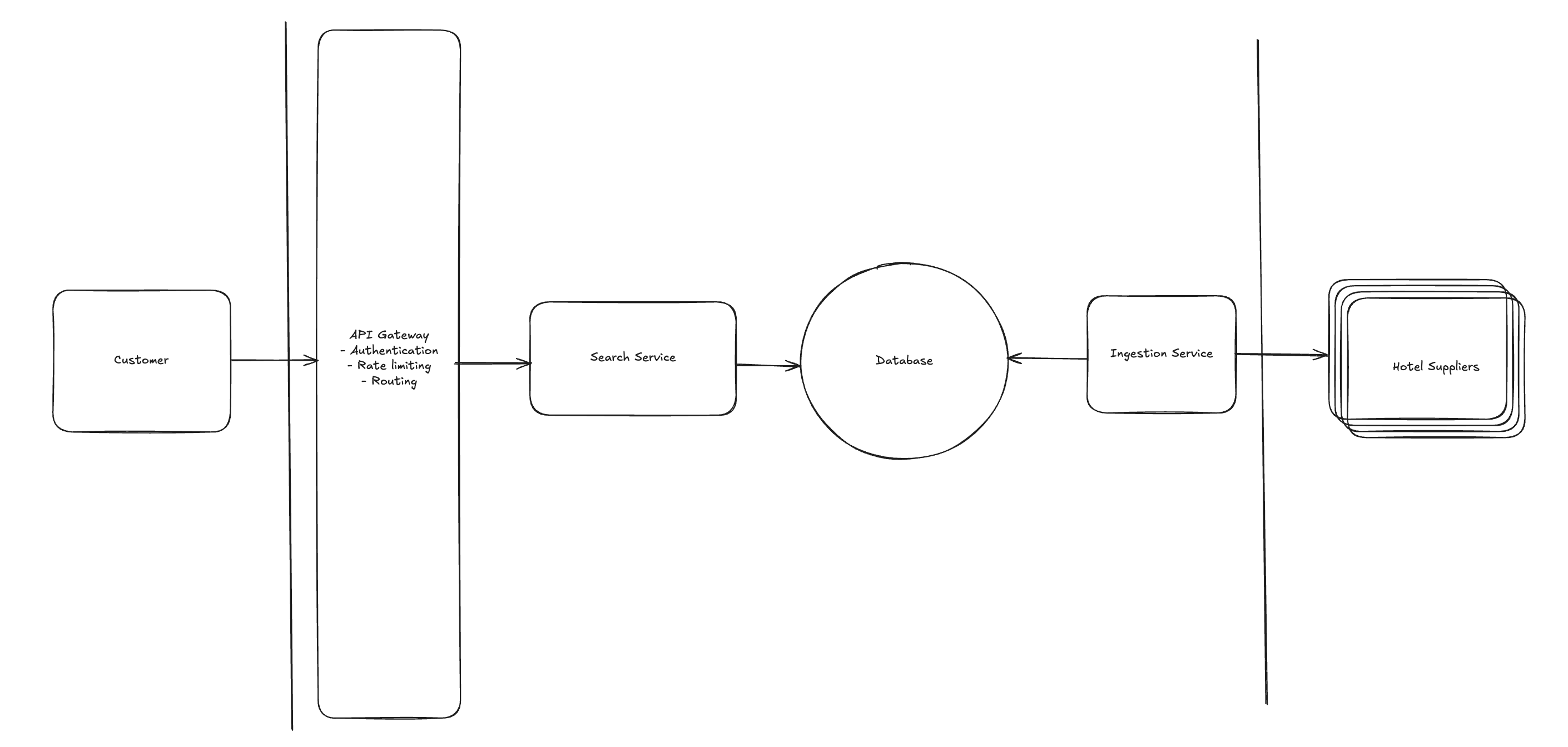
- The customer sends their location, dates, guest count, room count, and filters to the API Gateway.
- The gateway routes the request to the Search Service, which queries our database for matching hotels and room types with availability across the requested stay.
- The Search Service returns a page of hotels with booking options and prices.
A Supplier Ingestion Service periodically fetches hotel information, prices, and availability from suppliers and updates our database. Searches use this local snapshot, so they do not wait for supplier calls. Results may be slightly stale; checkout revalidates the selected option.
2. Users should be able to select and confirm a booking
We add a Booking Service to manage holds, payment, and reservation status.
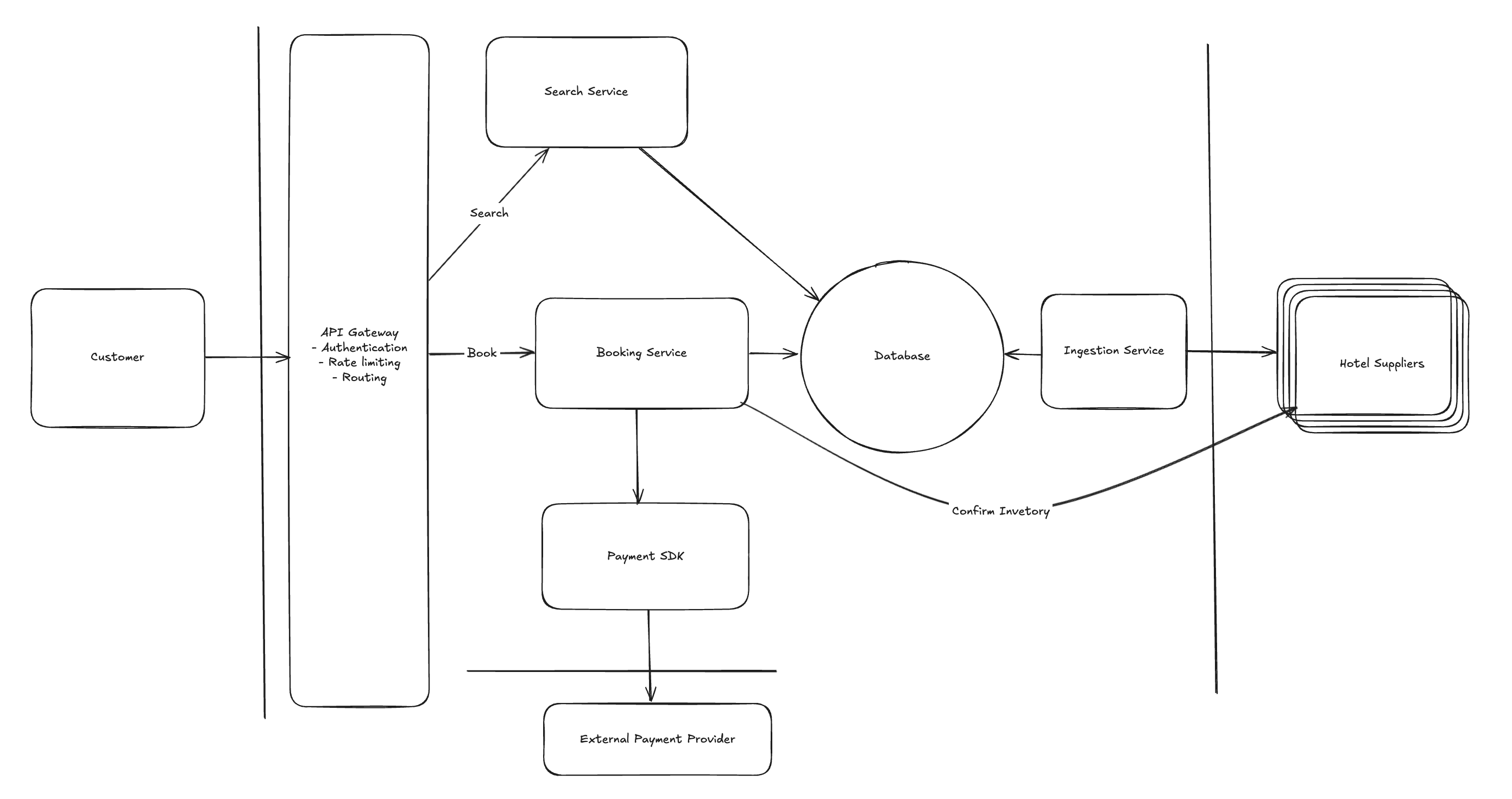
- Select and hold. The customer selects a booking option. The gateway routes the hold request to the Booking Service, which records an internal hold and creates a booking with status
held. It returns the booking ID and the ten-minute hold deadline. - Confirm and pay. The customer submits that booking ID and a payment-method token. The Booking Service validates ownership and the hold deadline, then updates the booking to
pending. It coordinates the supplier reservation and calls the external payment provider through its server-side payment SDK. - Return the result. Once the supplier reservation and payment are verified, the Booking Service updates the database to
confirmedand returns the booking ID and status. If an external outcome is still unresolved, the booking remainspending.
The Confirm Inventory connection covers revalidating availability and securing the supplier reservation. Payment success alone does not confirm a reservation.
The customer can call GET /v1/bookings/{booking_id} through the same gateway and Booking Service to check the current hold, payment, and confirmation status.
This is our minimum end-to-end design. We’ll cover scaling, failure recovery, hold expiry races, and late payments in the deep dives.
Deep Dives
1. How can we improve search to meet our low-latency requirements?
Our target is under 500 ms at p95, with up to 10,000 searches per second. Customers may combine hotel names, location, amenities, and star ratings, including misspelled search terms. How can we support these queries without overwhelming the database that also handles bookings?
Good solution: Use PostgreSQL’s search indexes
Approach
PostgreSQL is a capable starting point. It supports full-text search with tsvector and GIN indexes, similarity matching through pg_trgm, and geographic searches through PostGIS. An indexed ST_DWithin query can find hotels within a specified radius. We should not assume that text or location searches require a full table scan. Full-text indexes, trigram matching, PostGIS radius queries.
Challenges
As search traffic and query complexity grow, text matching, filtering, and ranking compete for database resources with booking operations. PostgreSQL may still meet our target with suitable tuning and capacity, but a dedicated search engine lets us scale and tune hotel discovery independently.
Improved solution: Add Elasticsearch for hotel discovery
Approach
Build a derived hotel search index in Elasticsearch, with one document per hotel. Index hotel names and descriptions for text search, coordinates as a geo_point, amenities as exact-match keywords, and star ratings as numbers.
For text search, an inverted index maps terms to matching hotel documents, avoiding a scan of every hotel’s description. PostgreSQL’s GIN text indexes use this principle too. Elasticsearch’s advantage here is a dedicated search platform for combining relevance ranking, typo tolerance, geographic filters, and independent search capacity.
For example, a customer searching for “Harbr Hotel” within five miles of their selected location can use fuzzy text matching alongside a distance filter, parking, and a minimum star rating. Fuzzy matching handles spelling variations; it does not automatically interpret arbitrary natural-language requests. Elasticsearch fuzzy queries, distance filters.
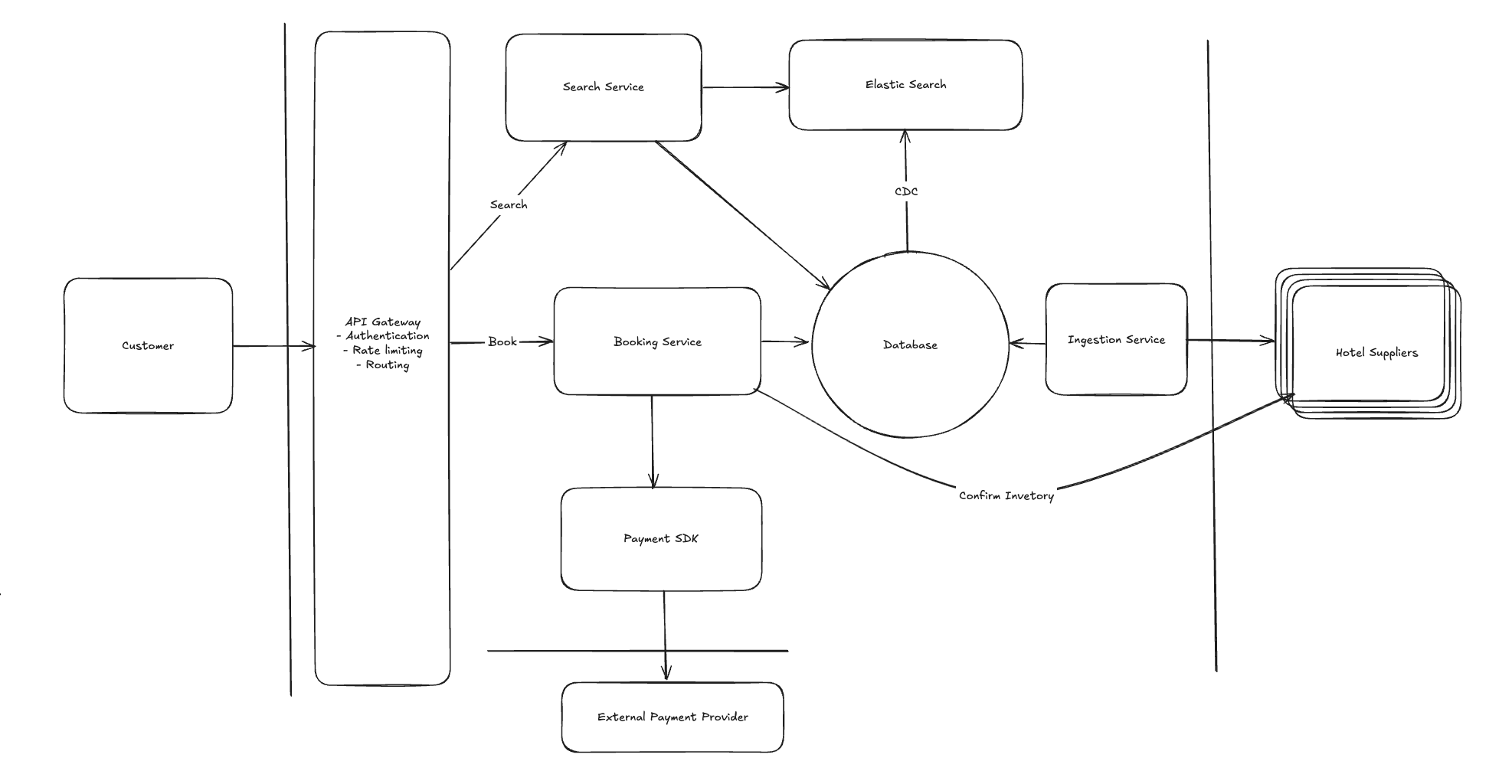
Before caching, the search path becomes:
- The Search Service queries Elasticsearch for a ranked batch of matching hotel IDs.
- It checks those hotels’ room availability and stay prices in PostgreSQL.
- It returns a page of hotels with valid booking options, fetching more candidates if availability filtering removes some matches.
Elasticsearch narrows the hotel search; PostgreSQL still checks availability across the requested nights. We’ll cover the exact room-night queries and indexes in the next deep dive.
Use change data capture (CDC) to keep the hotel index updated from PostgreSQL. A pipeline captures committed catalog changes, and an indexing worker assembles and updates the corresponding hotel documents. This is eventually consistent: updates become searchable after processing and index refresh, rather than immediately. Debezium is one option for capturing PostgreSQL changes. PostgreSQL CDC connector.
Challenges
- Synchronization: The pipeline must handle retries, deletes, and update ordering, with a way to rebuild the index. Monitor lag so stale hotel data does not go unnoticed.
- Operational cost: Elasticsearch adds another cluster to size, monitor, and recover.
- End-to-end latency: Faster hotel discovery does not guarantee the 500 ms target. Candidate retrieval and PostgreSQL availability checks share that budget; measure the full request under representative load.
Scale the availability reads with Redis
Elasticsearch removes discovery work from PostgreSQL, but checking room-nights for every search can still overload it. Add cache-aside Redis for reusable availability and rate snapshots. The Search Service reads Redis first and loads missing data from PostgreSQL; Redis does not query the database itself.
Cache inventory by (hotel, supplier, room_type, date) and fetch candidate keys in batches. Cache rates separately with their required rate-plan, occupancy, currency, and stay dimensions. This reuses hot hotel data across different searches. A location alone is not a safe key for priced booking options. Whole search-result caching is optional and must include all query parameters, sorting, and pagination.
Start with a 15–30 second TTL plus jitter as a tuning assumption. Each value retains its supplier observation time: renewing a cache entry does not make an old supplier snapshot fresh. Reject snapshots beyond the supplier freshness policy. Committed inventory and rate changes trigger asynchronous invalidation through CDC or an outbox; TTL limits how long a missed invalidation survives. Invalidation and cache fills can race, so this remains a best-effort search view. Redis expiration.
On misses, batch the indexed queries from the next section against a PostgreSQL read replica, with a separate connection pool and concurrency budget. Coalesce concurrent refreshes for the same keys, cap candidate batches and stay length, and stop candidate expansion at the request deadline. Replica lag is acceptable for browsing, but must be monitored alongside supplier age. Holds and booking-state reads use the primary.
Challenges: A cold cache or Redis outage must not send unlimited reads to PostgreSQL. Apply admission control to fallback reads; when capacity is exhausted, return explicitly incomplete results or a retryable search error. Measure hit rate, miss-path p95, replica lag, and database load under both warm-cache and cold-cache tests before claiming the latency target. If varied searches keep missing, build a dedicated availability read model rather than continually increasing load on booking storage.
Use a CDN for public hotel photos and versioned static assets. Authenticated booking responses and payment details stay out of shared caches. Neither Redis nor the CDN reserves inventory; checkout still checks the primary and obtains supplier confirmation.
2. How can we efficiently find available rooms across a date range?
Elasticsearch gives us candidate hotel IDs. On a Redis cache miss, our PostgreSQL read replica must answer: which supplier and room type can provide the requested quantity on every night of the stay?
Structure the table around room-nights
Store one row per hotel, supplier, room type, and night. This makes a stay a range of dated rows rather than a search through overlapping booking records.
CREATE TABLE room_night_availability (
    hotel_id        uuid NOT NULL,
    supplier_id     uuid NOT NULL,
    room_type_id    uuid NOT NULL,
    stay_date       date NOT NULL,
    available_count integer NOT NULL CHECK (available_count >= 0),
    sales_paused    boolean NOT NULL DEFAULT false,

    PRIMARY KEY (hotel_id, supplier_id, room_type_id, stay_date)
);
This is a simplified availability table; catalog details and prices live separately. Here, available_count is the stored remaining capacity our service can hold. Acquiring a hold decrements it; releasing a hold restores it. Supplier refreshes must preserve active holds and avoid subtracting confirmed bookings already reflected in the supplier’s count. We’ll cover that bookkeeping with the booking lifecycle.
Assume each supplier exposes one inventory pool per room type. Different rate plans can share that pool; they must not multiply its room count.
For a customer requesting two rooms from November 10 to November 13, the rows might look like this. IDs are shortened for readability.
| hotel_id | supplier_id | room_type_id | stay_date | available_count |
|---|---|---|---|---|
| H1 | S1 | Queen | 2026-11-10 | 4 |
| H1 | S1 | Queen | 2026-11-11 | 1 |
| H1 | S1 | Queen | 2026-11-12 | 3 |
| H1 | S1 | King | 2026-11-10 | 3 |
| H1 | S1 | King | 2026-11-11 | 2 |
| H1 | S1 | King | 2026-11-12 | 4 |
The stay includes November 10, 11, and 12. Check-out is excluded. Queen cannot satisfy the request because November 11 has only one room; King can provide two rooms throughout the stay.
Choose indexes for the two access patterns
The primary key prevents duplicate room-night rows and creates a unique B-tree index. Its ordering supports looking up dates for a selected hotel, supplier, and room type, as needed during checkout.
Search knows the candidate hotels but has not selected a supplier or room type. Add a second index:
CREATE INDEX availability_hotel_date_idx
ON room_night_availability (hotel_id, stay_date);
Hotel first, date second: find each candidate hotel, then scan just the requested date range across its room types and suppliers. The primary-key index places supplier and room type before date, so it is better suited to the selected-option lookup. These two indexes match different query shapes. PostgreSQL multicolumn indexes.
Query every night, not just one available night
Bind $1 to the candidate hotel IDs, $2 to check-in, $3 to check-out, and $4 to the requested room count. Validate a positive room count and a check-out date after check-in.
SELECT
    hotel_id,
    supplier_id,
    room_type_id,
    MIN(available_count) AS rooms_available_for_stay
FROM room_night_availability
WHERE hotel_id = ANY($1::uuid[])
  AND NOT sales_paused
  AND stay_date >= $2::date
  AND stay_date <  $3::date
GROUP BY hotel_id, supplier_id, room_type_id
HAVING COUNT(*) = ($3::date - $2::date)
   AND MIN(available_count) >= $4::integer;
For the example above, the result is:
| hotel_id | supplier_id | room_type_id | rooms_available_for_stay |
|---|---|---|---|
| H1 | S1 | King | 2 |
Two conditions make this correct:
COUNT(*) = number of nightsrejects missing dates. The primary key prevents duplicate dates within each group, so three rows in this three-night range cover the entire stay.MIN(available_count) >= room countchecks the tightest night. Summing availability would incorrectly accept Queen’s counts of4 + 1 + 3.
Grouping by supplier and room type prevents combining different room categories or suppliers across nights. The result identifies available inventory; we still apply guest capacity, rate-plan restrictions, and pricing to build booking options.
Performance and correctness limits: Batch candidate hotels in one query instead of querying each hotel separately. Inspect EXPLAIN (ANALYZE, BUFFERS) with representative data before adding more indexes. A covering index may reduce reads, but frequently updated availability rows can still require heap access and add index maintenance costs. PostgreSQL covering indexes.
Paused nights are excluded, so the night-count check rejects the entire stay if any night is paused. This query does not reserve rooms. The hold operation must atomically recheck and claim local capacity, and the supplier still decides final reservation availability.
3. How can we improve the booking experience by temporarily reserving rooms?
Acquire a hold when the customer clicks Reserve or Continue to checkout. Browsing does not reserve inventory. The hold gives the customer ten minutes to finish checkout.
Approach: Atomically decrement room-night counters
Use the room_night_availability table from the previous section. Its available_count is the remaining quantity our service can allocate. A three-night booking must claim three rows in one transaction; if any night is missing or has insufficient capacity, the entire hold fails.
Record the booking and exactly which quantities it claimed:
Booking
  booking_id             primary key (UUID)
  customer_id
  status
  hold_expires_at

BookingRoomNight
  booking_id
  hotel_id
  supplier_id
  room_type_id
  stay_date
  room_count
BookingRoomNight is a separate table, not another name for RoomNightAvailability. The inventory table stores how many rooms remain for a supplier’s room type on a date. The booking-room-night table records how many rooms a particular booking claimed on that date.
The four columns (hotel_id, supplier_id, room_type_id, stay_date) form a foreign key to room_night_availability. Together with booking_id, they form the junction table’s primary key. booking_id also references bookings. Require room_count > 0.
For example, a booking for two rooms over three nights has three BookingRoomNight rows, each with room_count = 2. The date identifies the night; room_count counts rooms, not nights. Multiple bookings can reference the same inventory row, each claiming part of its capacity.
The counter controls availability; the junction rows record what to restore. Do not subtract those allocations again when reading available_count.
Acquire the hold in a short transaction
The Booking Service generates a booking UUID and resolves the selected option into trusted supplier, hotel, room-type, date, and quantity parameters. Customer identity comes from authentication. The following is transaction pseudocode with bound parameters and explicit application checks:
BEGIN;

SELECT stay_date, available_count, sales_paused
FROM room_night_availability
WHERE hotel_id = :hotel_id
  AND supplier_id = :supplier_id
  AND room_type_id = :room_type_id
  AND stay_date >= :check_in
  AND stay_date < :check_out
ORDER BY stay_date
FOR UPDATE;

-- Application checks before proceeding:
-- 1. Row count equals check_out - check_in.
-- 2. Every available_count >= room_count and sales_paused is false.
-- If either fails: ROLLBACK and return UNAVAILABLE.

UPDATE room_night_availability
SET available_count = available_count - :room_count
WHERE hotel_id = :hotel_id
  AND supplier_id = :supplier_id
  AND room_type_id = :room_type_id
  AND stay_date >= :check_in
  AND stay_date < :check_out;

INSERT INTO bookings (
    booking_id, customer_id, status, hold_expires_at
)
VALUES (
    :booking_id, :customer_id, 'held',
    clock_timestamp() + INTERVAL '10 minutes'
);

INSERT INTO booking_room_nights (
    booking_id, hotel_id, supplier_id,
    room_type_id, stay_date, room_count
)
SELECT :booking_id, hotel_id, supplier_id,
       room_type_id, stay_date, :room_count
FROM room_night_availability
WHERE hotel_id = :hotel_id
  AND supplier_id = :supplier_id
  AND room_type_id = :room_type_id
  AND stay_date >= :check_in
  AND stay_date < :check_out;

COMMIT;
Validate dates and positive quantities before starting. The request’s idempotency key must also be claimed atomically with this transaction so a network retry returns the original booking instead of decrementing twice.
For two King rooms across our three example nights:
| Night | Before hold | Quantity claimed | After hold |
|---|---|---|---|
| November 10 | 3 | 2 | 1 |
| November 11 | 2 | 2 | 0 |
| November 12 | 4 | 2 | 2 |
If another customer requests the same stay concurrently, their conflicting SELECT ... FOR UPDATE waits. At PostgreSQL’s default Read Committed isolation, it then sees the updated locked rows. November 11 has zero remaining rooms, so the second hold fails. The first transaction commits all three decrements and the booking records together. PostgreSQL row locking.
Lock inventory rows in the same order across all write paths; for multiple room types, use the full composite-key order. This reduces deadlocks, but still handle deadlock errors with a bounded transaction retry. Keep supplier and payment calls outside these transactions; lock waits mean we cannot promise every transaction finishes in under 100 ms.
Release the database lock immediately; release inventory on expiry
Database row locks end at commit or rollback. The ten-minute checkout hold is represented by the booking record and the decremented counters, not by a database lock held open for ten minutes.
A periodic worker finds overdue held bookings. For each booking, it performs one transaction:
- Lock the booking row and recheck that it is still
heldand its deadline has passed. - Lock its room-night rows in the standard order.
- Add each junction row’s
room_countback to the correspondingavailable_count. - Set the booking to
expiredand commit.
The status transition and counter restoration happen together. A second worker or retry sees expired and does nothing, preventing double release. The junction rows remain as a record of what the booking claimed.
A normal read does not release capacity. With stored counters, expiry needs this write transaction. If the periodic worker is delayed, inventory can remain temporarily underavailable. We can later run the same reclamation operation before retrying a hold, but simply ignoring an expired booking in a query does not restore its counter.
Confirmation locks the booking row too, checks the deadline, and transitions held → pending. The expiry worker must not release pending bookings while supplier or payment outcomes remain unresolved. Payment completion and recovery are the next deep dive.
Supplier boundary: These counters coordinate customers within our service. Supplier ingestion must reconcile new snapshots with outstanding allocations under the same inventory locks, rather than overwrite counters or count confirmed reservations twice. Suppliers may share underlying rooms, so local counters cannot guarantee availability across suppliers or other booking sites; the selected supplier must accept the final reservation.
4. How do we prevent duplicate payments when customers click Pay multiple times?
A customer may double-click Pay, retry after a timeout, or open checkout in two tabs. One payment attempt must produce at most one charge, even if its request arrives repeatedly. Disabling the button improves the experience, but the backend must enforce this rule.
Generate one key per payment attempt
The client can generate a random UUID, for example with crypto.randomUUID(), when preparing a new payment attempt. It saves that key with the checkout state and reuses it for every submission or network retry of that same attempt. Do not generate a fresh key inside every click handler. A server-issued key is also valid, provided the client retrieves it before submitting payment.
POST /v1/bookings/booking_xyz/confirm
Authorization: Bearer <access_token>
Idempotency-Key: 4a193abc-e5d2-4c91-a74f-6c84a61c1482
Content-Type: application/json

{
  "payment_method_token": "pm_example"
}
Avoid keys based on rounded time. Two clicks at 10:09:59 and 10:10:00 would get different ten-minute buckets and could escape deduplication. Conversely, a legitimate retry with a different payment method after a decline could collide within the same bucket. An attempt’s identity should remain stable regardless of the clock. Stripe similarly recommends random UUIDs or other high-entropy keys. Idempotent request guidance.
Persist the attempt before calling the provider
Store an idempotency record linked to the payment attempt:
ConfirmationRequest
  customer_id
  idempotency_key
  booking_id
  request_fingerprint
  payment_attempt_id
  response_status
  response_body
  UNIQUE (customer_id, idempotency_key)

PaymentAttempt
  payment_attempt_id
  booking_id
  amount_minor
  currency
  status
  provider_payment_id
The fingerprint represents the operation, booking ID, and submitted payment-method reference. Reusing a key with different input returns 409 Conflict. The backend takes the amount and currency from the accepted booking price, never from an untrusted client amount. PaymentAttempt is the payment record introduced in our core entities.
In one short database transaction, the Booking Service:
- Claims the customer-scoped idempotency key. If it already exists, validates the fingerprint and returns the recorded result, or
202 Acceptedwhile it is in progress. - Locks the booking row and checks ownership and state. A confirmed booking returns its existing result; a pending booking cannot start another payment, even with a different key.
- For a valid held booking, creates the payment attempt, records its server-calculated amount, and transitions the booking to
pendingbefore committing.
The unique constraint handles repeated keys; the booking-row lock handles different keys from multiple tabs. The transaction ends before calling suppliers or the payment provider.
Reuse a stable key when calling the payment provider
Our API’s key deduplicates client requests. The backend also needs provider-side idempotency for its own retries. Derive that key from the persisted attempt ID and the operation:
payment:<payment_attempt_id>:chargePersist the attempt before the external call and reuse the same key and parameters on every retry. If the provider charged successfully but our service crashed before saving the response, a recovery worker resumes the same attempt instead of creating a new charge. Store the provider’s payment ID as soon as it is known and reconcile unresolved outcomes through provider status queries or verified webhooks.
| Situation | Action |
|---|---|
| Double-click or network retry | Reuse the same client key and payment attempt. |
| Another tab sends a different key | The booking’s pending state prevents another payment attempt. |
| Definitive decline, hold still valid | Allow an explicit new attempt with a new client key after safely returning the booking to held. |
| Timeout or unknown payment result | Keep the attempt pending; reconcile before allowing another attempt. |
| Booking already confirmed | Return the confirmed booking without charging again. |
Challenges
Provider idempotency records have retention limits. Do not blindly retry an unresolved charge after its deduplication window expires; query and reconcile its outcome first. Keep durable payment records and booking-state checks beyond the ten-minute hold. Deduplicate webhook event IDs and apply payment state changes transactionally so repeated notifications cannot repeat fulfillment or regress a completed payment.
On the frontend, disable Pay immediately while submission is in progress and show “Processing.” After a timeout, use GET /v1/bookings/{booking_id} to recover the current state. Payment success still requires supplier reservation confirmation before the booking becomes confirmed.
Bound recovery when only one external operation succeeds
Persist resolution_deadline, recovery_status, and the next reconciliation time with the booking. For example, after two minutes of uncertainty, escalate to an operator; after a stated customer deadline such as fifteen minutes, stop promising fulfillment and start compensation. These are business-policy examples, adjusted for supplier contracts and check-in proximity.
| Known outcome | Recovery |
|---|---|
| Payment succeeded; supplier uncertain | Keep the booking pending and tell the customer it is not confirmed. Query by the stable reservation reference; never issue a new reservation blindly. |
| Supplier rejected, or the resolution deadline passed | Mark fulfillment failed and, if payment was captured, durably enqueue an idempotent refund; and show refund_pending until verified. Request cancellation of any possible supplier reservation. |
| Supplier confirms after compensation started | Continue cancellation/refund recovery; do not silently confirm a booking already reported as failed. Escalate cancellation failures to operations. |
A deadline determines our customer-facing action; it cannot prove what happened at an unreachable supplier. Keep unresolved allocations quarantined from resale until reservation/cancellation reconciliation is safe, even after a refund. Recovery workers track this separately from booking status, alert on aging cases, and close the case only when financial and supplier outcomes are resolved. Where payment methods support it, authorizing first and capturing after supplier confirmation reduces refund cases, but authorization expiry and failed capture still need recovery. Separate authorization and capture.
5. How do we efficiently ingest supplier data and handle supplier outages?
The Supplier Ingestion Service maintains our local snapshots independently of customer searches. Use scheduled polling as the baseline and supplier webhooks where available. Each integration has its own capabilities and rate limits; our room-night model assumes the supplier exposes suitable inventory data. Suppliers that only return quotes for specific stays require a different adapter and quote-cache strategy.
Choose refresh frequency by data type and demand
There is no single correct cron interval. As initial design assumptions, subject to supplier quotas and caching agreements:
| Data | Example refresh policy |
|---|---|
| Hotel descriptions, amenities, photos | Daily, or when notified of a change |
| Popular properties and near-term inventory/prices | Every 1–5 minutes |
| Less popular properties or distant dates | Every 30–60 minutes |
| Selected option during checkout | Live supplier revalidation and reservation |
These intervals are tuning inputs, not freshness guarantees. Track snapshot age and supplier rejection rates to adjust them. Prefer incremental feeds and batched property/date requests where supported, and add jitter so all jobs do not run at once. Supplier pricing may depend on occupancy and stay length, so an adapter must preserve those dimensions rather than flatten every response into one nightly price. Example supplier pricing models.
Store supplier configuration separately from scheduled work
Supplier
  supplier_id              primary key
  name
  adapter_type
  credentials_secret_ref
  supports_webhooks
  supports_incremental_sync
  supports_holds
  supports_booking_idempotency
  requests_per_second_limit
  max_concurrent_requests
  enabled
  circuit_open_until

SupplierSyncState
  sync_id                  primary key
  supplier_id              foreign key to Supplier
  scope_key                property/date batch identifier
  data_type                catalog or availability_prices
  scheduler_schedule_id    reference to external schedule
  cursor                   supplier incremental-sync checkpoint
  last_success_at
  last_error
  UNIQUE (supplier_id, scope_key, data_type)

SupplierSyncRun
  run_id                   primary key; stable across redelivery
  sync_id                  foreign key to SupplierSyncState
  status                   running, succeeded, or failed
  lease_expires_at
  lease_token
  attempt_count
The external scheduler owns refresh timing; the external queue owns message delivery; PostgreSQL stores checkpoints and processing results. One supplier may serve thousands of properties, so schedule bounded property/date batches rather than one giant supplier-wide job. Property and room-type mappings retain the supplier’s external IDs. Credentials live in a secret store; the table holds only a reference.
Use an external scheduler, durable queue, and worker pool
Configure recurring schedules using the refresh policies above. Each scheduled occurrence publishes a message containing a stable run_id and sync_id to the external job queue. Retries of that occurrence retain the same run ID. Configure delivery retries and a dead-letter destination for scheduler-to-queue failures so a failed publish is visible and recoverable.
Ingestion workers consume messages from the queue; they do not poll PostgreSQL for due jobs:
- Load the supplier configuration and current sync checkpoint. Claim the run in PostgreSQL, skipping already successful runs. Serialize work for the same sync scope, including webhook-triggered refreshes, so overlapping jobs cannot race to advance its cursor.
- Call the supplier outside any database transaction, respecting shared per-supplier rate and concurrency limits. Reserve capacity for customer checkout calls.
- Validate and normalize the response. In one transaction, verify current worker ownership, apply the updates, advance the checkpoint, and mark the run successful.
- Acknowledge the queue message after that commit. If the worker crashes after committing but before acknowledging, redelivery finds the completed run and does not apply it again.
The queue temporarily hides an in-flight message using a visibility timeout or delivery lease. Workers extend it for long-running calls; after a crash, the queue makes the message available again. Database processing leases and tokens protect against a worker applying a late result after another worker takes over. They track ownership, not refresh scheduling.
Retry transient failures with capped exponential backoff and jitter, respecting Retry-After when supplied. A delayed retry must be durably scheduled before acknowledging the original message. After a bounded number of failures, send the message to a dead-letter queue and alert. Coalesce redundant refreshes for a scope so an offline supplier does not accumulate an unbounded backlog.
Periodic polling resumes through the external schedule. Changing a property’s refresh frequency updates that schedule rather than a PostgreSQL next_run_at column.
Accept optional webhooks through the same ingestion path
Expose a supplier-specific endpoint such as POST /v1/suppliers/{supplier_id}/inventory-events. Authenticate the sender using the agreed mechanism, verify signatures and replay protection where supported, and durably record the event before acknowledging it.
Deduplicate by supplier and event ID. Write the received event and an outbox entry in one transaction; an outbox publisher reliably forwards work to the same external queue. A notification can trigger a targeted refresh, or carry a versioned update that workers apply directly. Compare supplier versions before overwriting newer data. Arrival time alone does not prove freshness; without reliable versions, use notifications as refresh hints and serialize refreshes for the same scope. Keep periodic reconciliation because notifications can be missed.
Handle failures according to the operation
| Failure | Behavior |
|---|---|
| Background refresh times out | Keep the last good snapshot and its original timestamp; retry later. A failed fetch does not mean zero availability. |
| Snapshot exceeds its freshness limit | Suppress its bookable options or show availability as unknown; other suppliers remain searchable. |
| Repeated supplier failures | Temporarily open a per-supplier circuit breaker, then allow limited recovery probes. Pause and alert on persistent authentication or schema errors. |
| Read-only checkout revalidation fails | Return a retryable error without proceeding to payment; do not extend the internal hold indefinitely. |
| Reservation call times out | Keep the booking pending: the supplier may have accepted it. Reconcile using the booking reference or retry with the same supported idempotency key. |
If the supplier lacks idempotent booking and status lookup, do not blindly repeat an uncertain reservation request; it may require supplier support or manual reconciliation. If payment already succeeded, preserve that outcome and follow the resolution deadline and compensation policy from the payment deep dive.
Protect internal holds during ingestion. Store raw supplier counts, source versions, and observation times separately from our mutable available_count. Applying a refresh must use the same room-night locks as booking operations and account for allocations not yet reflected in the supplier snapshot. When that cannot be determined reliably, preserve existing claims and reconcile conservatively rather than advertise newly freed capacity. Ingestion must never reset the counter to the latest raw supplier count and erase active holds.
What if a refresh reports fewer rooms than our existing claims?
Our adapter normalizes the supplier’s reported count to remaining inventory, not total rooms. Do not subtract all confirmed bookings again if the supplier has already accounted for them. Reconcile against the supplier version/checkpoint and only subtract local claims not reflected in that snapshot, plus a configurable safety buffer. The buffer reduces rejection risk; it cannot guarantee inventory against other sales channels.
If the refreshed capacity cannot cover those claims, set sales_paused on the affected room-nights under the same locks used by holds. Keep existing allocation records, invalidate search snapshots, and reject new holds for those nights while reconciling. Do not silently revoke supplier-confirmed reservations or let expiry increments reopen paused inventory. If the supplier cannot establish which claims are reflected, keep sales paused until reconciled. Recompute the remaining capacity before clearing the flag.
For example, if the supplier reports one remaining room but we have two local holds it has not seen, we stop new sales. Both holds remain provisional; only a successful supplier reservation guarantees fulfillment. Show this clearly during checkout. Use shorter freshness limits, larger buffers, or earlier supplier holds for products with high rejection rates.
Monitor job lag, snapshot age, rate-limit responses, and booking-time supplier rejections. Background outages can reduce freshness; they must not turn an unknown reservation outcome into a false confirmation or a duplicate booking.
6. How do we recover if PostgreSQL fails during checkout?
Use one writable primary with a synchronous standby in another availability zone. Acknowledge critical booking, idempotency, payment, and outbox writes only after WAL is durably flushed on both. If that durability requirement cannot be met, pause checkout writes rather than silently acknowledge weaker durability. Failover must fence the old primary before promoting an eligible standby. Separate asynchronous read replicas serve search misses. PostgreSQL synchronous replication.
If a commit succeeded but the response was lost, the client retries with the same key and receives the recorded result. If the crash occurred after an external call, recovery resumes the persisted operation and queries the provider before retrying. Database replication cannot make supplier and payment calls atomic.
For regional disasters, keep cross-region WAL archives/backups and test restoration. Asynchronous disaster recovery has a nonzero data-loss window; define recovery objectives explicitly and reconcile external operations before reopening affected bookings. A zero-loss regional requirement would need cross-region synchronous durability and its latency/availability tradeoff.
Final Design
Our final design separates hotel discovery, supplier ingestion, and booking coordination. Elasticsearch finds hotels, Redis serves reusable availability/rate snapshots, and the CDN serves public static assets. PostgreSQL remains the durable store for inventory allocations and bookings, with read replicas for bounded search-cache misses.
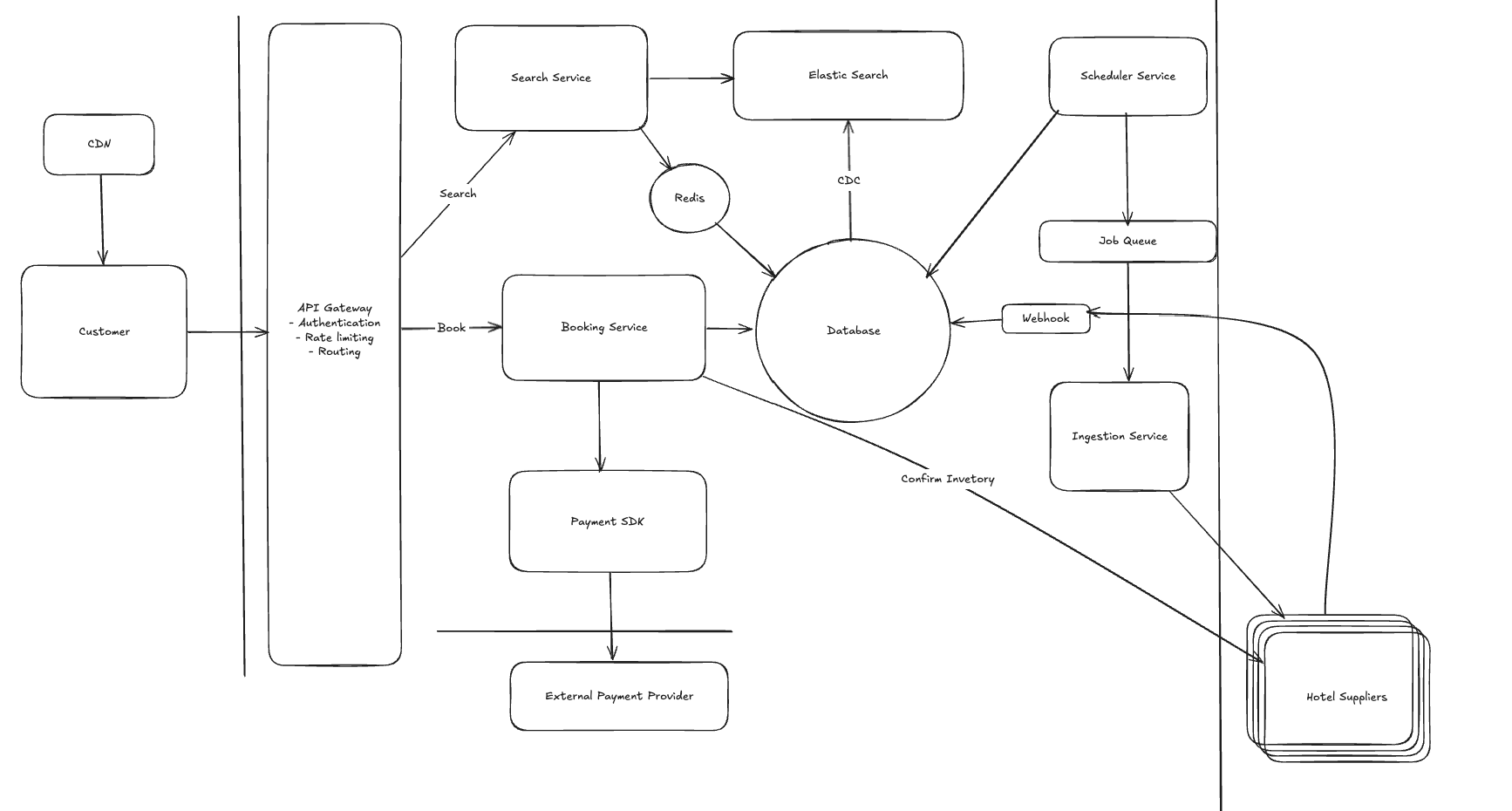
Open the full-resolution diagram to zoom in.
The Redis-to-database arrow represents cache-aside reads performed by the Search Service. The database symbol includes a primary, standby, and search read replicas; it is not one unreplicated node. The Payment SDK runs inside the Booking Service. The Scheduler Service and Job Queue are external components. PostgreSQL stores supplier configuration, sync checkpoints, and run results; ingestion workers consume the queue. Ingestion workers write normalized supplier responses back to PostgreSQL, although that return connection is omitted from the drawing. The webhook connection represents durable receipt followed by validated ingestion, not an unchecked overwrite of inventory.
Search flow
- The customer submits location, dates, guest count, room count, and filters through the API Gateway.
- The Search Service queries Elasticsearch for matching hotel IDs.
- It batch-reads availability and rate snapshots from Redis. Cache misses use bounded queries against a PostgreSQL read replica and populate Redis with short TTLs.
- It checks every requested night, applies pricing and restrictions, and returns paginated booking options. Search remains best-effort; holds check the primary and checkout revalidates with the supplier. The CDN serves public photos and static assets.
Supplier ingestion flow
- The external scheduler publishes refresh jobs to the durable queue, and ingestion workers consume them.
- Workers fetch catalog, pricing, and availability updates within each supplier’s rate limits. Optional webhooks trigger targeted refreshes or supply versioned updates.
- Workers normalize and reconcile the data in PostgreSQL, preserving internal holds and accounting for existing reservations. CDC updates the hotel search index in Elasticsearch; committed availability/rate changes also trigger Redis invalidation.
- Failed jobs retry with backoff. We retain the last good snapshot and suppress bookable options once that data exceeds its freshness limit.
Booking flow
- The customer selects a booking option and starts checkout. The API Gateway routes the authenticated hold request to the Booking Service.
- In one PostgreSQL transaction, the service locks the requested room-night rows, checks every night, decrements
available_count, and creates theheldbooking and itsBookingRoomNightrecords. - Commit releases the database locks. The customer receives the booking ID and a ten-minute checkout deadline.
- When the customer clicks Pay, the client submits a payment-method token and an idempotency key reused for retries of that attempt.
- The Booking Service verifies ownership and the deadline, records the attempt, and atomically changes the booking to
pending. - It revalidates the option, obtains a supplier hold where supported, and coordinates payment and reservation confirmation. Stable external-operation keys protect retries.
- Once both outcomes are verified, the booking becomes
confirmed. Uncertain outcomes staypendinguntil resolved or the recovery deadline starts compensation, with refund/cancellation progress tracked separately. The customer can checkGET /v1/bookings/{booking_id}at any time. - A periodic worker expires abandoned
heldbookings and restores their room-night counts exactly once. Unresolved external allocations remain quarantined until safe to release; paused inventory is not reopened by expiry.
Final data model
These are the main records and relationships; PK denotes a primary key and FK a foreign key. We assume each booking selects one supplier and room type, with a room count that applies throughout the stay.
Customers and hotel catalog
Customer
  customer_id              PK
  name
  email

Hotel
  hotel_id                 PK
  name
  latitude
  longitude
  timezone
  star_rating
  amenities

RoomType
  room_type_id             PK
  hotel_id                 FK → Hotel
  name
  max_guests
  description
  amenities

Supplier
  supplier_id              PK
  name
  adapter_type
  credentials_secret_ref
  supports_webhooks
  supports_incremental_sync
  supports_holds
  supports_booking_idempotency
  requests_per_second_limit
  max_concurrent_requests
  enabled
  circuit_open_until
Hotel does not need a room_types[] column: RoomType.hotel_id provides that relationship. Supplier-specific identifiers live in the mapping table below.
Room-night inventory
RoomNightAvailability
  hotel_id                 FK → Hotel
  supplier_id              FK → Supplier
  room_type_id             FK → RoomType
  stay_date
  supplier_reported_count
  available_count
  sales_paused             blocks new holds during reconciliation
  source_version
  observed_at

  PK (hotel_id, supplier_id, room_type_id, stay_date)
  INDEX (hotel_id, stay_date)
supplier_reported_count is the latest raw supplier count; available_count is the reconciled capacity our service can allocate. Holds decrement the latter, and expiry restores it; sales_paused overrides that count until reconciliation completes. Refreshes must preserve allocations and avoid counting confirmed reservations twice. source_version is nullable when the supplier provides no version; observed_at records when we obtained the snapshot.
Bookings and their nightly allocations
Booking
  booking_id               PK
  customer_id              FK → Customer
  hotel_id                 FK → Hotel
  supplier_id              FK → Supplier
  room_type_id             FK → RoomType
  check_in
  check_out
  guest_count
  room_count
  status
  hold_expires_at
  resolution_deadline
  recovery_status
  next_reconcile_at
  quoted_total_minor
  currency
  booking_terms_snapshot
  supplier_reservation_id
  created_at

BookingRoomNight
  booking_id               FK → Booking
  hotel_id
  supplier_id
  room_type_id
  stay_date
  room_count

  PK (booking_id, hotel_id, supplier_id,
      room_type_id, stay_date)

  FK (hotel_id, supplier_id, room_type_id, stay_date)
     → RoomNightAvailability
Booking describes the stay; BookingRoomNight records each night’s claim. Two rooms for three nights produce one booking and three allocation rows, each with room_count = 2. Enforce that room types belong to their hotels and that allocation rows match the booking’s supplier, room type, dates, and quantity. The accepted price and terms are snapshots so later catalog changes do not rewrite the customer’s agreement.
Payment attempts and request deduplication
PaymentAttempt
  payment_attempt_id       PK
  booking_id               FK → Booking
  amount_minor
  currency
  status
  provider_payment_id
  created_at

ConfirmationRequest
  customer_id              FK → Customer
  idempotency_key
  booking_id               FK → Booking
  request_fingerprint
  payment_attempt_id       FK → PaymentAttempt, nullable
  response_status
  response_body

  PK (customer_id, idempotency_key)
A booking may have multiple payment attempts after definitive declines, but only one active attempt at a time. A confirmation request can return an existing booking state without creating a new payment attempt. Payment status stays separate from booking status. Hold requests use the same durable request-deduplication pattern, scoped to the hold operation.
Supporting records
| Table | Key fields and purpose |
|---|---|
| SupplierRoomMapping | Supplier ID, external hotel and room-type IDs, internal hotel and room-type IDs. Uniquely identifies each supplier product mapping. |
| SupplierRatePlan / Rate data | Supplier product, rate-plan ID, currency, price, meals, cancellation terms, and occupancy/stay restrictions. Rates retain the dimensions required by the supplier; multiple plans may share one inventory pool. |
| SupplierSyncState | Sync ID, supplier ID, scope, data type, external schedule ID, cursor, and last success/error. Unique per supplier, scope, and data type. |
| SupplierSyncRun | Stable run ID, sync ID, processing status, lease token/expiry, and attempt count. Deduplicates queue redelivery and records worker ownership. |
| WebhookInbox | Source, event ID, payload, processing status, and receipt time. A unique source/event pair prevents duplicate processing. |
| OutboxEvent | Event ID, event type, related booking or sync ID, payload, and delivery state. Written with the associated database change for reliable notifications and webhook-to-queue delivery. |
Useful operational indexes include Booking(customer_id, created_at) for customer history, Booking(hold_expires_at) WHERE status = 'held' for expiry scans, PaymentAttempt(booking_id) for payment lookup, and SupplierSyncRun(sync_id, status) for sync-run lookup. Refresh scheduling and delivery are handled by the external scheduler and queue.
Redis snapshots and CDN assets are disposable derived data, not additional authoritative tables. Recovery workers also index Booking(next_reconcile_at) for unresolved recovery cases.
Booking options remain short-lived search results assembled from supplier products, rates, and availability. They do not require a permanent table; selecting one creates the durable booking record.